

The first black tea recorded
In 1732, a new kind of tea that was black in colour of the leaves but yielded a red liquor was traded in an area called Xing Cun (星村) in Wuyi (武夷) in the northwestern part of Fujian (福建). It was the first ever documented evidence of the appearance of what currently understood as black tea.*
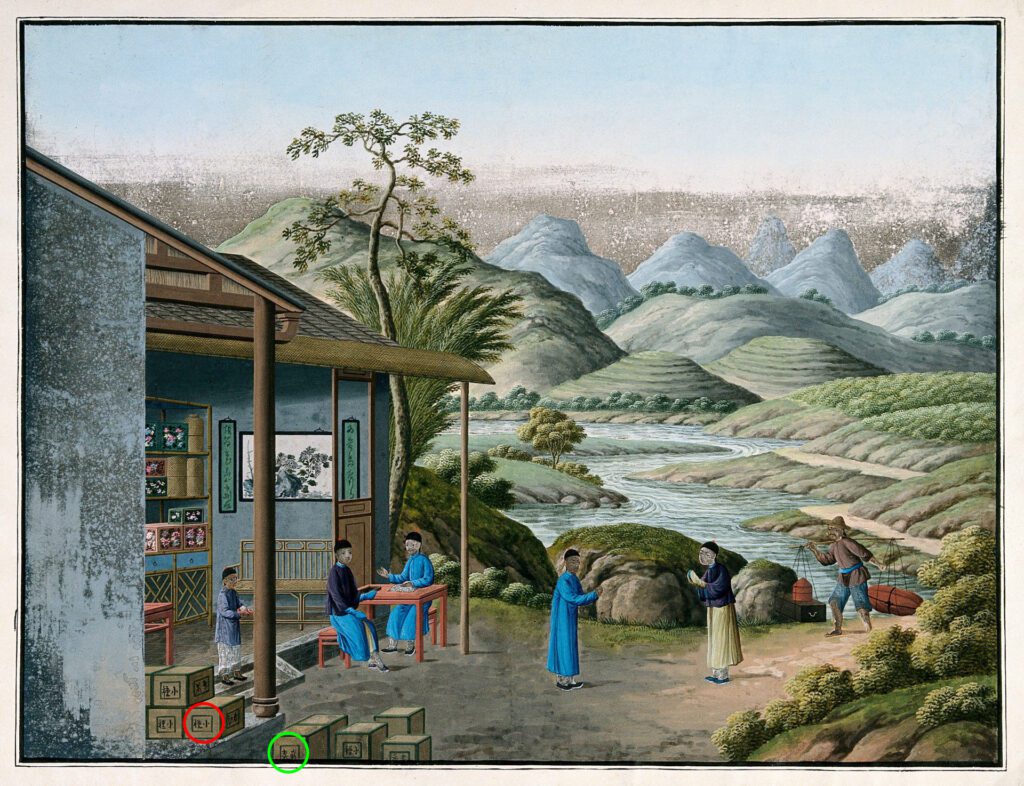
In a painting from a series of nine paintings of tea cultivation and processing, the artist depicts a transaction of tea already packed in wooden chests in a house next to a winding river. The chests are labelled “Xiao-zhong” (“小種”) (red circle) and “Wuyi” (“武夷”) (green circle). The winding river ( a main river in the Wuyi Shan region is nicknamed Nine Bend River ) is painted next to tea fields with dome shaped mountains in the background. This is an abstraction of a typical landscape in the Wuyi area. Gouache on silk, with oxidisation/mould ruining some of the areas, late 18th century. Wellcome Collection, London
No further written materials or artefacts can be found from that same era as to the production details or taste of that tea. Some suspected that it must have been the more abundant tea plant that was widely used for export production of that era: Meizhan. In the 90’s a cultivar is developed from this bustard of tea ( a lot of Meizhan production plants in use have sexually propagated ancestries ) to reconstruct the tea that could have been first traded in the 18th century. The epicentre of it all is Tongmuguan (桐木關), where not only the long craft tradition and the terroir for black tea production, but also for its historic significance — it is right above the water route for tea trading via Xing Cun.
Tea Hong’s Tongmuguan One is a quintessential representation of the best quality of this Meizhan black tea.
Come to this tea for its complexities and nuances in the taste profile. It is not the easiest black tea to infuse well, but the rewards for a well-brewed cup is very satisfying.
For a more straightforward black tea with simpler pleasure, there is Lapsang Souchong Pristine.
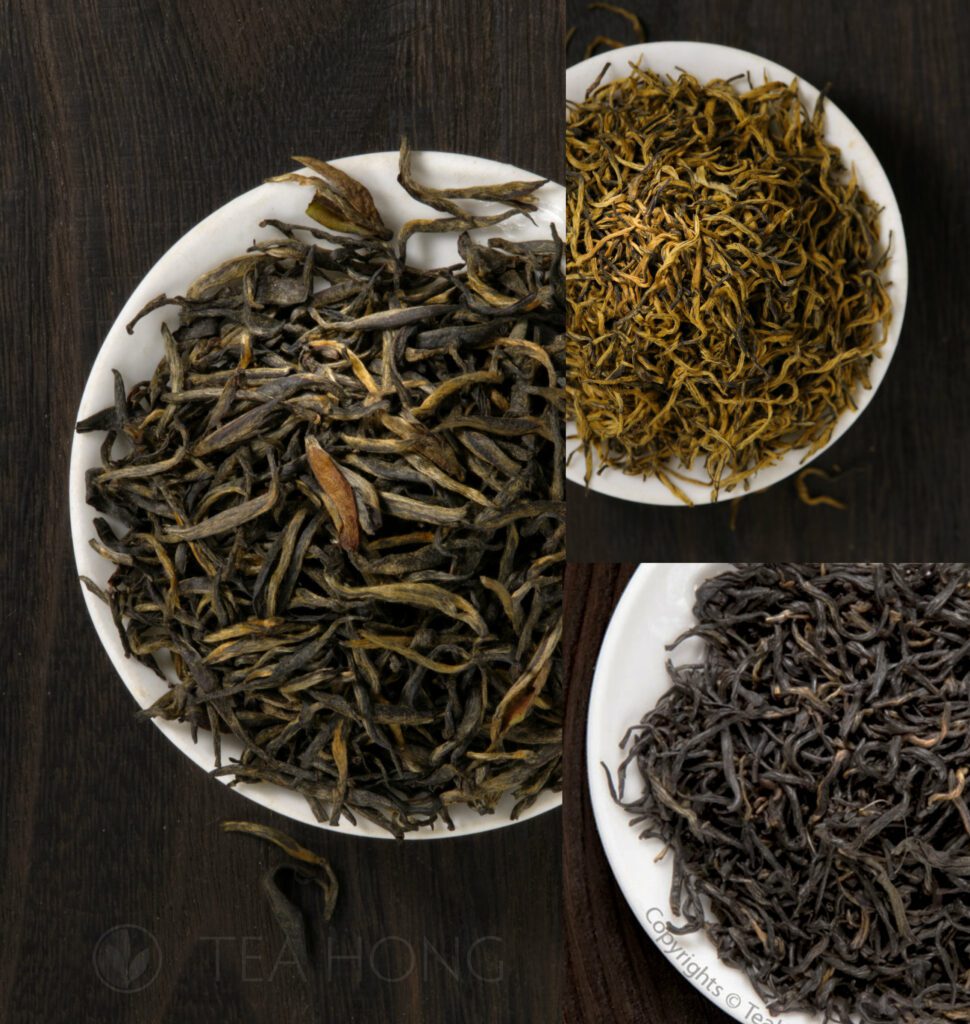
Three black teas from the birthplace of black tea: Tongmuguan One (left), Gold Stallion (top right), and Lapsang Souchong Pristine (bottom right)
Lapsang Souchong, the original non-smoked version
The funny name Lapsang Souchong is neither English nor any of the Chinese languages, not entirely. ( Forget those stories you read on the internet, even those on Wikipedia ) The phrase Souchong is quite surely an early romanisation of the phrase “small leaf variety” ( Xiao-zhong in Mandarin, Xie-zuo in Minbei, Siao-ziong in Minnan, Siu-zung in Cantonese^ ). The name appeared as early as 1800 in tea menus in England ( black tea was invented for export afterall )**, but without the prefix Lapsang.
Contrary to all the fables that you can find on the internet, the word Lapsang does not transliterate to anything meaningful in any of the Chinese languages. Where the sound “sang” can be associated with some dialects/languages as either ‘pine’ or ‘mountain’, but putting a sound “lap” in front of it does not amount to anything relevant. We suspect it was an invention to sell a “Souchong”.
The proper name of the tea has always been Zheng-shan Xiao-zhong, meaning a small leaf variety (black tea) genuinely from the (Wuyi) Mountains, implying that there are those products that look like it, but not from this region.
The very first smoked batch of Souchong was simply bad manufacturing: someone used bad smoky fuel to bake dry the tea and let the smoke get into the leaves in the process. Somehow the export market liked it.
Yet up to this day, people do not drink this in Wuyi, nor in China, nor in any parts of East Asia. They much prefer the original Souchong from Wuyi-shan proper: clean, sweet and delightfully refreshing aftertaste.
That is exactly why we add the word “Pristine” to our “small leaf variety black tea genuinely from the Wuyi Mountains”, to differentiate from the smoky version.
If, however, you seek a bit more glamour beyond this humble looking fine tea, maybe this other variety from this fertile region could be a choice.
Gold Stallion, or Eyebrow of the Gold Stallion — Jin Jun Mei
First produced in the 90’s from a newly developed cultivar also in the area of Xing Cun, and during the height of the explosive wave of economic boom in China, the tiny and neat looking downy golden leaves of the Gold Stallion soon won the hearts of many of the nouveau riche. The price simply shot over the ceiling until the recent decade, as have those of many other teas.
Now the finest of this soft, warm and sweet aroma of this fine black tea can be enjoyed by all at a far more accessible price. Made possible only at Tea Hong, of course.
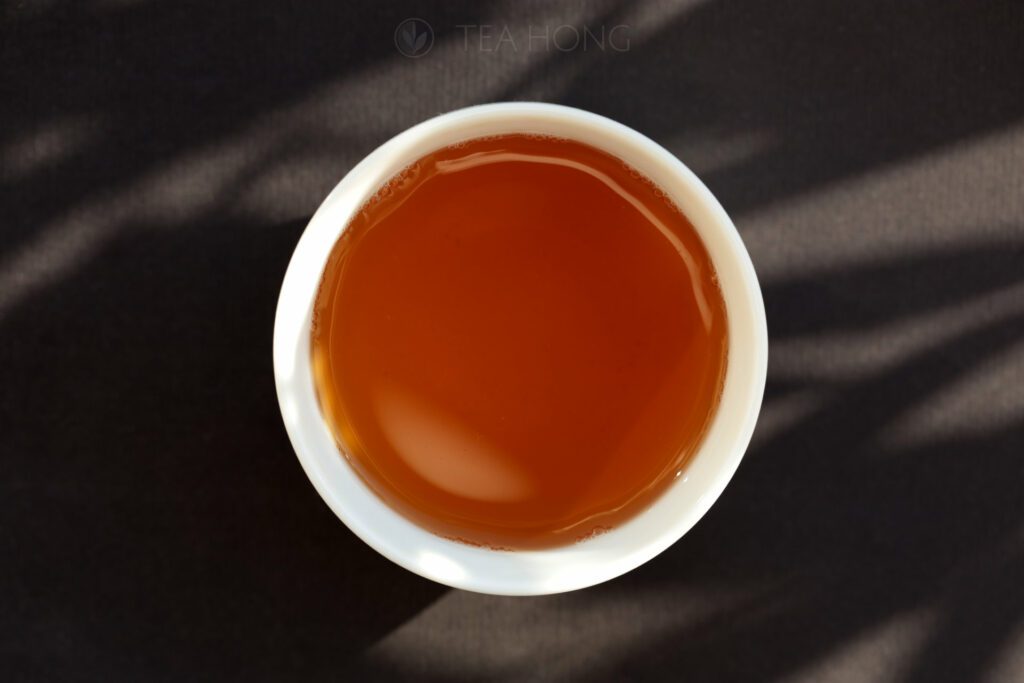
Infusion colour, Gold Stallion (Jin Jun Mei)
notes:
* The Tea Guardian: Black Tea: Origin & Production
^Canton and Xiamen were the two tea export ports in those era, so it is more possible that the English language interpretation of the names originated from the Cantonese or Minnan languages, rather than that of the origin, Minbei, or the then central government language, Mandarin
**The Tea Guardian: Lapsang Souchong, The Original Version

Comments (0)
Leave a reply
You must be logged in to post a comment.