A private message
A few nights ago, the customer who had left the most number of reviews on our site, N.N., sent me a message saying, “…I’ve been enjoying the Fengxi Old Ginger the past couple days. When I brew it up following your parameters (5 grams of leaf in my Happiness gaiwan) the flavors concentrate a lot and it’s very enjoyable. The notes of apricot-glazed shortbread compress into something more like lingonberry and juniper, and the congwei comes out in full force. It’s really tasty!”
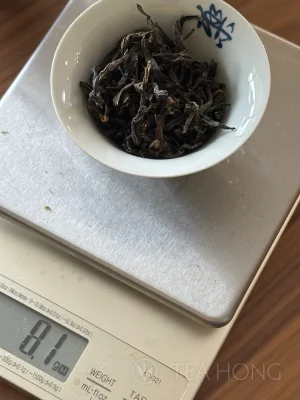
This is my usual portion of classic style dancongs when making tea for pure enjoyment. I rarely weigh it in such instances, but doing so just to make this photo to show you. The gaiwan in the photo is exactly the Happiness Gaiwan that N.N. mentioned.
The next day he sent another message, “…6 grams this time, 30 second initial steep at 192°F / 89°C. I like this a lot. I’m getting some dry pine and fir coming off the wet leaf, reminds me strongly of Christmas!”
I smiled as I read it.
For my own drinking, I actually use 7g. Same size gaiwan. Same 30 sec. Sometimes even 8g for a more matured Phoenix if I choose to use a lower temperature, like 85°C or even a touch lower.
When I have time for tea as the focus, I prefer a sip that is strong enough to touch deep, and with a truly substantial taste, naturally.
A small refuge under the tree
In 1979 when I first walked the streets in China by myself after the slowing down of Cultural Revolution (contrary to what is being told in “formal history”), there was still the humbleness of men sitting quietly under the tree with their small gongfu tea sets, escaping the pressure of realities in a cup of strong tea. I had sat with them and shared their bitterness.
In 1999 when I first visited Chauzhou, the Gongfu Tea Capital of the World — and the home city of Fenghuang, for tea sourcing, I met an old man sitting with his small gongfu set right next to a busy bus terminal, making tea in his tiny, seriously impregnated clay pot that was submerged in a bowl of hot water (that was what used to be called chahai, before the name somehow got stolen to label the tea decanter). The cup held at most 15ml of liquor. It was much stronger than my regular 7~8g infusions, but that taste lingers on till today.
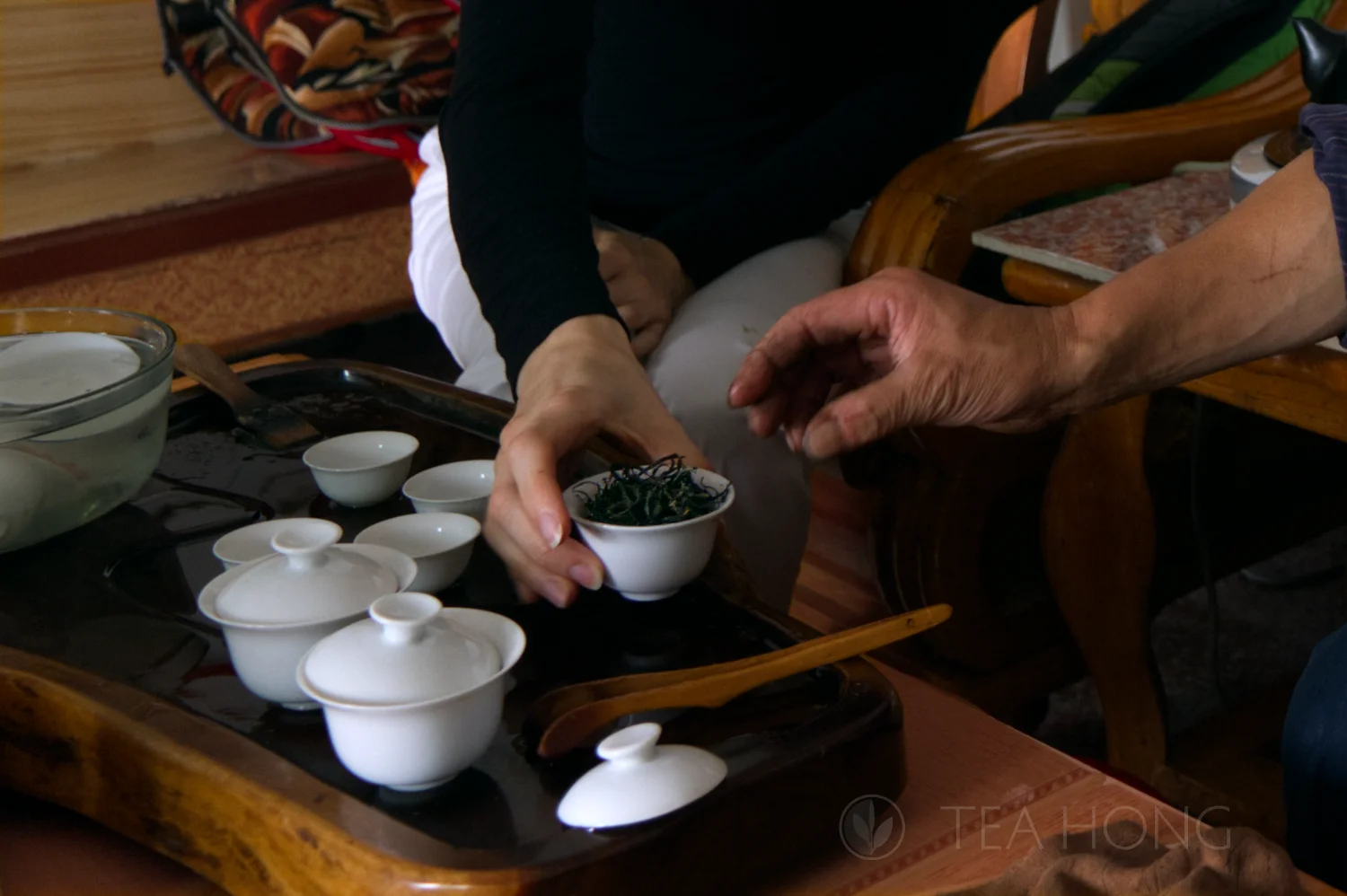
How much leaves in the gaiwan for making tea? At the tea farms, Fenghuang farmers usually fill the gaiwan with leaves to make tea for visiting guests to taste their tea. The gaiwans in the pictures are slightly smaller than the Happiness Gaiwan in the upper picture, at about 70ml. Notice how much the bowl is filled as compare to the 8g in the upper picture. Chen’s farm in Wudong, Fenghuang, Guangdong.
The day before yesterday, we went to a tea ceremony place with two visiting clients from Europe and asked in particular for both usucha and koicha in the “ceremony”. The host first served up usucha 薄茶 — thin tea. It was good, but not special, nor made any impression on me. When the koicha 濃茶 — strong tea — was served, it brought climax to the whole event. The taste and sipping experience lingered on till dinner.
Tea ceremony — usucha? koicha?
The younger member of our client party said he did not like the koicha as much as he liked the usucha though, and took a very long time to finish the bowl. The older one, however, enjoyed it very much and kept describing about the feelings and tastes afterwards.
The host later showed us the two entirely different grades of matcha that were used. Their shop’s average level one for the usucha, and their premium top grade for the koicha.
The older guest, together with Olivia and myself like the koicha much better and had been impressed. The younger guest did not feel it that way.
Perhaps it says something about how people like tea.
As how it goes for matcha, the same may also be the case for Fenghuang dancong, or perhaps many things else.
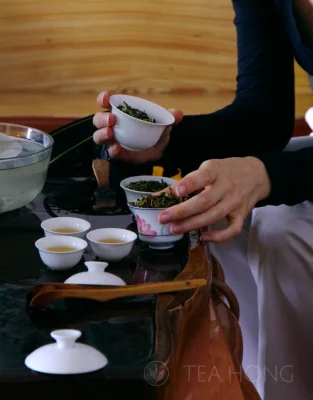
A visiting guest examining the leaves in the gaiwan as she went through the same tea tasting experience like that I first had at the turn of the century in Wudong.
Is a good tea a companion? Or a focus?
Indeed, we make our Fenghuang light and easy too. For during meals, during work, or a cup to sip from when watching a movie or the nightly news. With a superb quality leaf, a lightly infused liquor, as long as done properly, tastes enjoyable and keeps the day going. It is our de facto drink companion.
However, a strong enough sip gets you into another dimension. It opens the door to broader horizons. It gets deeper into my soul.
A good Phoenix stimulates and pacifies at the same time. Its complexity and mouthfeel hits deep and levitates. To me, more than any other tea, or any other thing.
Infusion tips
In the infusion tips or suggestion on the product pages, I habitually offer a starting point for alternative ways to make tea in a lighter proportion or shorter infusion time for readers to begin the journey. I am happy some of you have gone on with deeper variations for a truer and more substantial experience. The true wonders of these wonderful tea awaits you, when you are ready to let it bring you to higher levels of tea experience.
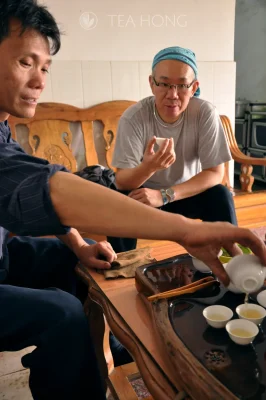
Tea tasting in Chen’s farm in Wudong, Fenghuang, 2010. My visitor from France took this picture of me tasting. Most other visitors are usually too overwhelmed to take any pictures, let alone an old tea man like me.
Comments (0)
Leave a reply
You must be logged in to post a comment.