
Old Hong Kong as a trading centre
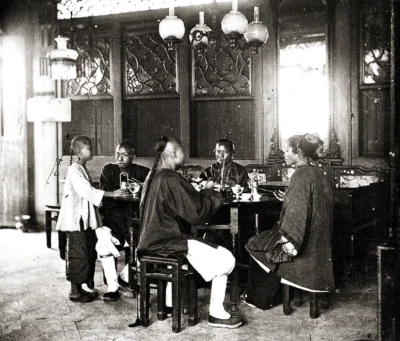
In a Hong Kong teahouse in the late 19th century. Unlike those setups for the grassroot, elites have always enjoyed space exclusivity. It was likely that they wouldn’t be having the kind of Pu’er we are introducing here.
For most of the 20th century until the 1980’s, the not so delicate looking large dried tea leaves from Yunnan, especially those overgrown ones, were almost entirely sold to Hong Kong. The tiny city, governed by the British then, had always been a free port and thus the most important export channel for teas from China. These rough looking leaves were sold to Hong Kong merchants at unwanted prices. For a small city experiencing a four fold population bloom because of the influx of refugees since 1949, such cheap leaves would not only satisfy this dramatic surge in market need, but was also an important commodity for exporting to the still impoverished economies in Southeast Asia.
The raw leaves (the original meaning of the name before the term shengcha was adapted as the present name) were not conveniently useable though — bitter and overly sharp for daily drinking especially when brewed without attention by people who were struggling to survive.
“Wet Storage” — the origin of post-fermentation
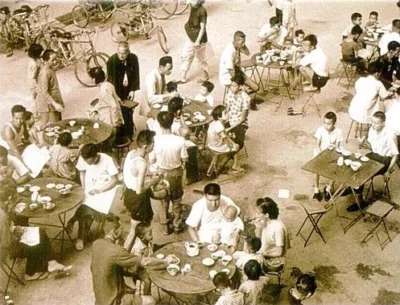
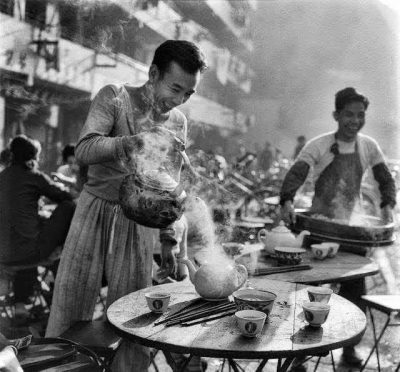
In an open air grassroot eatery in the early 1960’s. Affordable tea was a basic necessity.
Somehow, a “wet storage” method began to propagate amongst tea merchants to transform the leaves into something easy to brew, sweet and smooth to the taste, and with a distinctive earthy and mesmerising aroma. They conveniently used the same name given to the category of the compressed tea discus from Yunnan — Pou Nei — the same name as Pu’er in written Chinese when romanised according to Cantonese pronunciation. (In case you do not know, Cantonese is the main language in Hong Kong.) It was the most popular tea back then. A must have in teahouses, dimsum restaurants, grassroot eateries, and even an occasional presence in my sub-poverty childhood household.
In the early 1970’s, as some Communist government officers began to gain a little sense towards the last few years of the catastrophically violent and destructive Cultural Revolution because of the realistic need for income, this affordable and popular “wet storage” Pou Nei exporting from Hong Kong but relying on the supply from China, caught their attention.
“Modernisation”
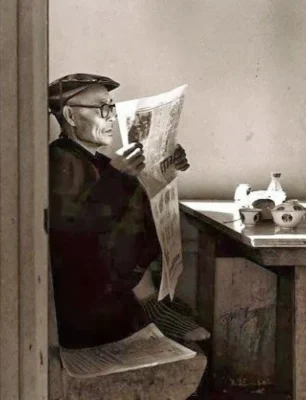
The teahouse, be it elitists’ one or for the mass, has been a treasured space in the congested city.
A tea specialist native of Yunnan with a small team were sent to visit some of the Hong Kong tea merchants to study their techniques. In Yunnan where the land mass was well over 350 times that of the British colony, and tea trees are everywhere, Zou Bing Liang, that tea specialist, simply scaled up the production and summarised the processing he learned in Hong Kong into an easy to follow procedure. While in those days they still relied on Hong Kong for sales, but turning the raw leaves into the dark tea that saved the work for Hong Kong merchants allowed them to raise the price for more profits. He was later to become the ‘Father’ of modern day shu cha Pu’er.
This modern version, however, is somewhat different from the tea as I remember it in my childhood era. A little bit something is missing.
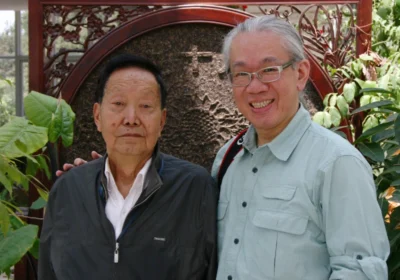
In a 2014 visit to Zou Bing Liang’s tea factory in Yunnan to talk with him in details about the status of Pu’er production and his experience in Hong Kong.
Reconstructing the original
Introducing Tea Hong’s Old Hong Kong Pou Nei, our take on reconstructing the sweet memory of the comforting refuge of sipping something enjoyable during a struggling childhood.
This is the tea that has the strongest presence in my early memories about drinks. It was served when there was a guest visiting; or in the rare occasion when I was taken to a dim sum place; it was the first tea on the first day of Lunar New Year, with sugared coconut, lotus seeds and water chestnuts… until when we were less poor and could sometimes afford tea steeped in the thermo flask on normal days.
Delivering the true quality as I remember it, afterall, is the only thing I can do to hold on to a true beautiful tradition. In a world that is flooded with vulgarity, bad tastes, fake information, alternative reality and pretentious expertise, a small sip which taste that registers a delicate memory is all the more precious.
Old Hong Kong Pou Nei is the first of Tea Hong’s Remembering Old Hong Kong series. Please subscribe for updates.
The impression of the taste of the few varieties of tea that I had when I was a small boy in the 1960’s is very different from what people are serving in the dimsum restaurants today. Because of this memory, the Remembering Old Hong Kong series is created.

Comments (0)
Leave a reply
You must be logged in to post a comment.